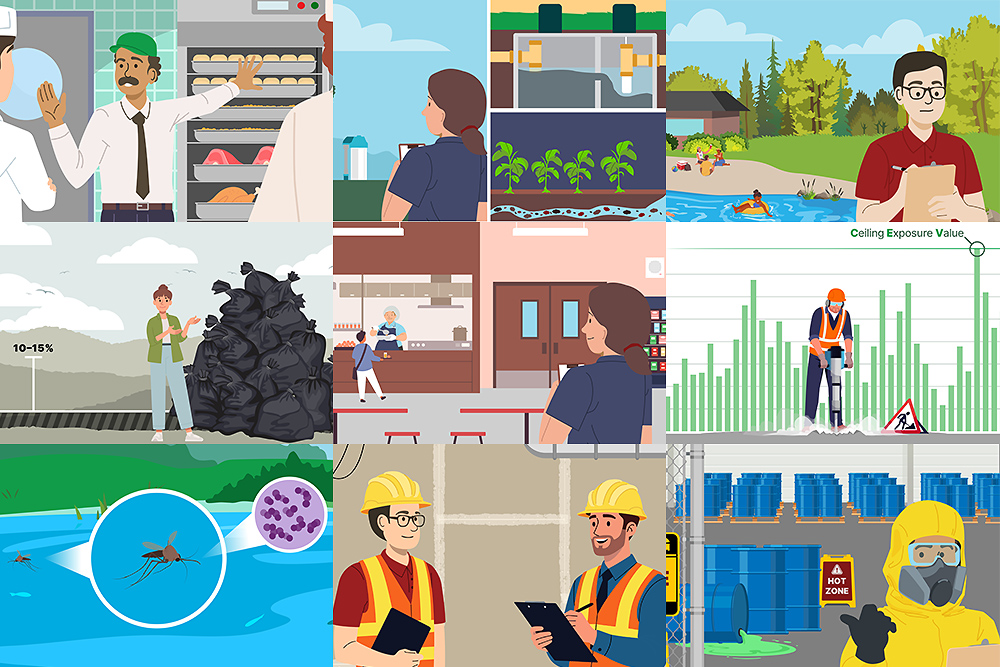
This course offers an introduction to the field of environmental public health, with a focus on key topic areas for today’s workforce, including food safety, clean water, solid and hazardous waste, and more. Each module in this course explores scenes from real life public health practice with a focus on the application of evidence-based environmental health concepts. Through case examples and video-based lessons, you will learn how to make a positive impact on your community’s health and be better prepared for success in environmental health and related roles.
Intended Audience
- Public health professionals or other professionals with an interest in environmental health roles (e.g., environmental health specialists, registered sanitarians, industrial hygienists, health inspectors, health and safety specialists)
- Public health and environmental health professionals who have some background in environmental health
- Students or new professionals who have little or no prior training in environmental health
Learning Objectives
After taking this training, participants will be able to:
- List and describe nine key areas of environmental health practice
- Describe the core responsibilities of environmental health specialists, sanitarians, and related roles
- Explain practical situations where professionals use evidence-based methods from environmental health science to address problems
- Identify resources and tools that environmental health professionals can use on the job
Technical Requirements
The online modules were designed to work in most modern browsers, operating systems, and devices.
Accessibility
The online modules are delivered in a 508-compliant interface. During the development of this training, we strived to make the content accessible to individuals using screen readers. If you encounter trouble accessing the modules by screen reader, please contact NWCPHP, and we will do our best to make sure the content is accessible to you.
Acknowledgements
NWCPHP would like to thank Dr. Gary Brown at Eastern Kentucky University, Chad Lynch and Morgan Clements at the Kentucky Department for Public Health, and Dr. Diana Hamer and Jaime Jimenez at the National Network of Public Health Institutes for their contributions to this project.
This work is supported by funds made available from the Centers for Disease Control and Prevention (CDC) of the U.S. Department of Health and Human Services (HHS), National Center for STLT Public Health Infrastructure and Workforce, through OE22-2203: Strengthening U.S. Public Health Infrastructure, Workforce, and Data Systems grant. The contents are those of the author(s) and do not necessarily represent the official views of, nor an endorsement, by CDC/HHS, or the U.S. Government.