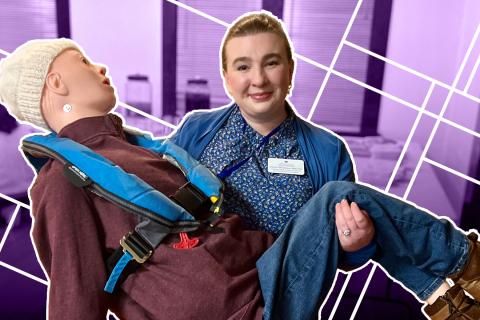
Autumn Dennistoun working with the manikin named Phil.
Autumn Dennistoun worked as a labor and delivery nurse, but after working through the pandemic, she realized she was meeting her patients too late in their care journey.
“I realized that what my patients were experiencing often began long before they ever saw me at the hospital. No matter how strong my nursing care was, I felt like I was getting to them too late,” she said.
Motivated by this, Dennistoun pursued her Doctor of Nursing Practice (DNP) in Population Health and Systems Leadership, at the University of Washington to focus on the upstream factors that were impacting her patients’ health.
While she didn’t enter the program expecting to focus on opioid overdose prevention among commercial fishers, Dennistoun was introduced to occupational health issues through coursework and mentorship opportunities. Around the same time, she found research on opioid use in the workplace and saw the opportunity to connect the two.
What began as a literature review evolved into conversations with people in and around the industry, which helped her better understand how opioid use was affecting fishing communities and what barriers existed to addressing it.
For her final DNP project, she partnered with the Pacific Northwest Agricultural Safety and Health Center (PNASH) to develop hands-on naloxone training tailored to fishers using a manikin named Phil.
“Fishers are very tactile because their jobs are hands on,” said Dennistoun. “They like working with their hands, so Phil helps them learn how to deliver naloxone, which helps people feel comfortable should they need to use it while they’re out at sea.”
With Phil in hand, Dennistoun led trainings with participants and later brought the same interactive approach to the Washington Fishermen’s Convention, where she also provided naloxone kits, stickers, and handouts. Feedback from these sessions was overwhelmingly positive. “People at outreach events or presentations would say, ‘wow this is such an important and much-needed project,’” said Dennistoun.
As the project grew, the next challenge was scale. Reaching a highly dispersed and sometimes uncounted workforce is no easy task. “The geographic area for fishers is huge,” said Dennistoun. “It can be really challenging to get the word out about the training. There are about 8,100 fishing vessels across our region, but how many fishers are there really?”
To reach more communities, Dennistoun is collaborating with the Northwest Center for Public Health Practice (NWCPHP) to enhance the initial training and make it broader.
“We’re focusing on expanding to fishing communities across Washington, Idaho, Alaska, and Oregon. NWCPHP has such a talented team. It felt like a natural fit with their expertise in technology and informational design.”
The expanded training will be shaped directly by the fishing community it aims to serve. A recently completed survey asked fishers about preferred learning formats, experiences with opioid use, and whether stigma is a barrier to seeking help. The feedback will be incorporated into the revisions and the new version is set to launch mid-summer.
“At its core, this work is about reducing overdose fatalities. Even if it’s just one, that alone would make it worth it” said Dennistoun. “But it’s also about normalizing conversations around overdose so people feel safe asking for help and getting connected to care. And for me, this work is personal. My own family history has included commercial fishers, some who have died at sea. If this effort can change someone else’s story, that’s what matters most.”
Reflecting on her path through the DNP program to this work, Dennistoun says the experience has reshaped how she sees her profession. “Nurses can exist anywhere; it doesn’t have to be limited to hospitals or clinics. You can take your skills and knowledge and use them in new and innovative ways to meet people where they are,” said Dennistoun.