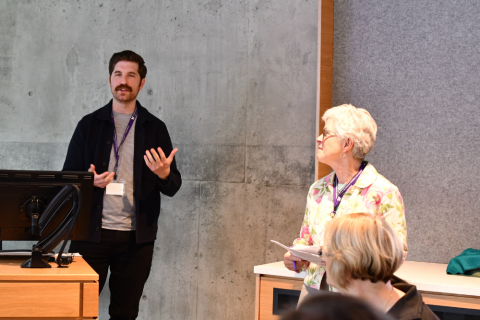
Kevin deVoss, Lead Instructional Designer (left) and Betty Bekemeier, Director, present learning material that was later used in an ECHO series about crisis leadership.
The Northwest Center for Public Health Practice (NWCPHP) is using the ECHO model to strengthen peer learning.
The Extension for Community Healthcare Outcomes (ECHO) Model uses case studies, peer learning, and active participant engagement to find practical solutions to complex public health problems. Initially created to support rural clinicians, ECHO has been described as the “anti-webinar” due to its minimal reliance on lectures and its emphasis on shared learning.
“ECHO democratizes the learning process,” said Barbara Rose, Training and Outreach Manager. “Instead of a top-down approach, it embraces the fact that learning is social and that everyone brings valuable knowledge to the table.”
In a typical ECHO session, a subject matter expert opens with a brief overview (10-15 minutes) of a public health topic. A participant then presents a real-world story describing how the issue appears in their work, along with the challenges and potential solutions they’ve encountered. The group then engages in facilitated discussion, drawing connections across experiences, sharing insights, and identifying next steps.
“In clinical settings, solutions are more direct and can be identified within a session,” said Kevin deVoss, Lead Instructional Designer. “In public health, however, we’re addressing structural challenges with complex factors that need to be discussed over multiple sessions.”
NWCPHP has created multiple ECHO series on topics related to community health assessments and public health management, and is eager to develop more. “We’ve found that people really love peer learning because ECHO respects the knowledge and experiences of those working in the field,” said Rose. “It validates both the complexity of public health work and the importance of communities of practice.”
Currently, NWCPHP is partnering with the Northwest Center for Evidence-Based Public Health Emergency Preparedness and Response to integrate ECHO into their Crisis Leadership Institute (CLI). The CLI brings together professionals in management and leadership roles across state, local, and Tribal emergency preparedness efforts to build crisis leadership skills. ECHO offers participants a space to share experiences and explore how they apply skills that may not always be captured in research.
“Crisis leadership often depends on soft skills that are developed through experience in high-stakes environments,” said deVoss. “That kind of on-the-job knowledge can be difficult to capture in a one-off workshop or webinar. ECHO helps balance practice-based stories, lived experience, and evidence-based approaches that are taught elsewhere in the CLI.”
The cohort’s first two ECHO sessions of the series have successfully fostered connection and meaningful discussion around core leadership skills. The team plans to evaluate participant experiences to refine the series for future cohorts. They’re also exploring additional topics, like crisis communication, where ECHO could be applied.
“There are many public health topics that lend themselves to ECHO,” said Rose. “Public health work is inherently multifaceted and draws on knowledge from many sectors. You need a space for people to come together and discuss how they can apply all that diverse expertise to address community challenges.”
“I’d love to see ECHO become a more widely recognized model across public health,” said deVoss. “With tools like iECHO connecting participants globally, there’s real potential to create ongoing spaces where people can share experiences and collaboratively develop solutions.”
Contact Barbara Rose to learn more about NWCPHP's ECHO for public health services and how to use them to advance learning with your team.